
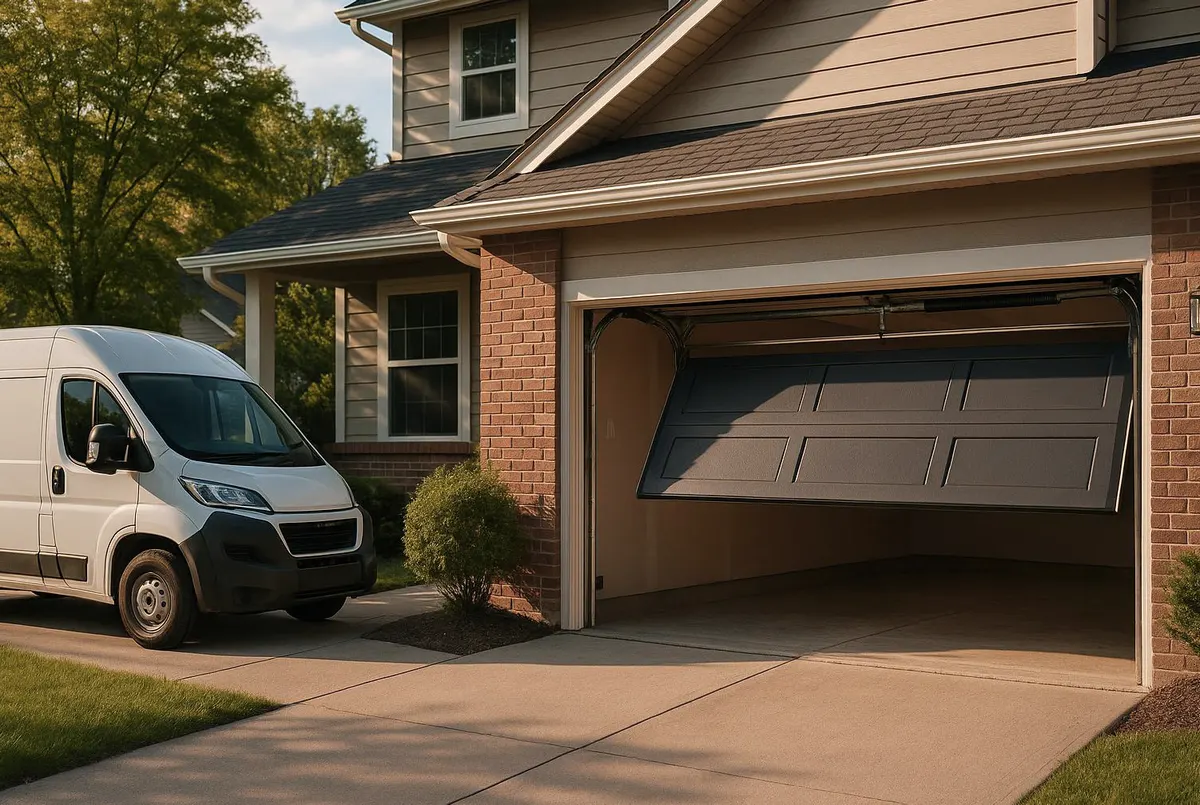
Rule of thumb: lubricate every moving metal part on your garage door twice a year with a silicone or lithium-based spray, never with WD-40 or household oil. The exceptions matter more here than in drier climates. If you're close enough to feel salt air, or your garage sits low and catches standing humidity after afternoon downpours, you'll want to lubricate every three to four months instead. New doors still under warranty should get whatever lubricant the manufacturer specifies, since some warranties are picky about that.
Tools You'll Need
- Silicone-based garage door lubricant spray, or a white lithium grease made for garage door hardware
- Clean cotton rags
- A small stiff brush, like an old toothbrush
- A shop vacuum or handheld vacuum with a crevice tool
- A sturdy step ladder
- Safety glasses
- A flashlight for checking inside the track and spring coils
Step-by-Step: Lubricating Your Garage Door
- Close the door and disconnect power to the opener. Unplug it or flip the breaker. You'll be working near moving parts, and you don't want the door activating while your hands are on the track.
- Do a visual inspection before you touch anything. Look for rust on hinges and hardware, frayed or broken cable strands, flat spots on rollers, and gaps where the track has pulled away from the wall. Florida humidity and the occasional coastal salt exposure speed up rust on hardware that looks fine from a distance, so get the flashlight in close.
- Clean the tracks first. Vacuum out pollen, dirt, and the gritty film that humid air leaves behind on metal. Wipe the tracks with a dry rag. Never lubricate a dirty track — you'll just be grinding grit into the rollers.
- Lubricate the hinges. Spray a light coat on each hinge where the metal pieces pivot against each other. Open and close the door by hand a few inches to work it into the joint, then wipe off any excess that drips.
- Lubricate the rollers. If you have steel rollers, spray the bearings at the center of each wheel, not the roller surface itself. Nylon rollers with sealed bearings need only a light spray at the stem where it meets the hinge bracket.
- Lubricate the springs. Apply a light, even coat along the length of the torsion spring (the one mounted horizontally above the door) or extension springs (the ones running along the upper tracks). Cycle the door a couple of times by hand, with the opener still disconnected, so the lubricant works into the coils.
- Lubricate the opener's drive mechanism. For a chain-drive opener, apply a light coat along the chain. For a screw-drive opener, grease the threaded rod with the lithium grease, not the silicone spray, since screw drives need something thicker to stay put.
- Put a drop of lubricant in the lock mechanism if your door has a manual lock, working the key or latch a few times afterward.
- Wipe down every part you sprayed. Excess lubricant attracts dust and pollen, which turns into a gritty paste in humid air. A light coat that's been worked in and wiped off does more good than a heavy coat left dripping.
- Reconnect the opener and run the door through a few full cycles, watching and listening for grinding, squeaking that didn't go away, or jerky movement. Test the auto-reverse safety feature by placing a block of wood in the door's path and confirming it reverses on contact.
What to Avoid
- WD-40 is a solvent and moisture displacer, not a lubricant. It will quiet a squeak for a day or two, then evaporate and leave the metal drier than before, which means more friction and faster wear.
- Motor oil or household 3-in-1 oil is too thin. It runs off quickly, especially in heat, and doesn't hold up to repeated cycling.
- Heavy automotive chassis grease is too thick for garage door hardware. It collects dust and dirt into a paste that gums up rollers and hinges over time.
- Petroleum-based products on rubber weatherstripping will dry out and crack the rubber faster, which matters in a climate where that seal is already working overtime against wind-driven rain.
Where the Line Is: Homeowner vs. Technician
Lubricating hinges, rollers, the opener rail, and the lock mechanism is safe, reasonable homeowner maintenance. Cleaning tracks and doing a visual inspection is, too. But there's a hard line at anything involving spring tension. Torsion springs are under extreme tension and have caused serious injuries when homeowners try to adjust or replace them without the right bars and training. If a spring looks stretched, rusted through, or has a visible gap in the coil, don't lubricate around it and call it done — that's a repair, not a maintenance task. Bent track, a door that's come off its rollers, or cables that are fraying at the drum are also technician jobs, not weekend projects.
When to Call Fort Meade Garage Door Pro
If your door is still noisy or sluggish after a proper lubrication job, that's usually a sign of something mechanical rather than something a spray can fix — worn rollers, a spring losing tension, or a track that's slightly out of alignment from humidity-driven wood swelling around the frame. Our Garage Door Maintenance & Tune-Up service covers a full hardware inspection, tension checks, and track alignment that goes beyond what's safe to do from a ladder at home. If you've already spotted a cable fraying or a roller that's cracked or flat-spotted, our Cable & Roller Replacement service handles that before it turns into a door that jumps the track entirely.
If you're in Fort Meade, Bartow, Mulberry, Lake Wales, or anywhere else in Polk County and your door needs more than a can of silicone spray, give Fort Meade Garage Door Pro a call. We'll take a look, tell you honestly what it needs, and get it handled fast.